Non-idealities in artificial synapses | Nature Reviews Physics
Non-idealities in artificial synapses | Nature Reviews Physics
https://www.nature.com/articles/s42254-026-00957-2
Publish Date: 2026-07-09 05:00:00
Source Domain: www.nature.com
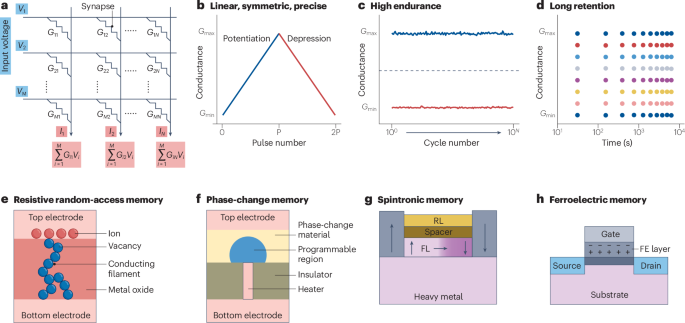
- The article discusses various types of memory devices proposed for neuromorphic computing and their application in deep learning.
- Key types of memory devices mentioned include resistive random-access memory (RRAM), phase-change memory (PCM), magnetic tunnel junctions (MTJs), and ferroelectric field-effect transistors (FeFET).
- The work emphasizes the importance of endurance, retention, and linearity of these devices for effective neuromorphic and deep learning applications.
- Recent advances in materials science, such as incorporating HfOx, Ge2Sb2Te5, and other nanocomposites, are highlighted for their beneficial properties for neuromorphic devices.
- The discussion extends to challenges such as process variation, linearity, symmetry, and resistance drift, and how these affect the practical implementation and performance of neuromorphic systems.
- The article also touches on the potential applications of these devices in brain-inspired computing and unconventional computing paradigms.
- In-memory computing and the integration of memory and processing within a single device architecture are highlighted as key strategies for enhancing the efficiency of deep learning computations.
- The potential of probabilistic and stochastic behavior in devices like memristors for enabling Bayesian inference and machine learning tasks is explored.