7 Everyday Distributions Explained Simply
7 Everyday Distributions Explained Simply
https://www.kdnuggets.com/7-everyday-distributions-explained-simply
Publish Date: 2026-06-27 02:55:08
Source Domain: www.kdnuggets.com
Summary:
The article offers a straightforward and accessible guide to seven prominent statistical distributions that frequently appear in real-world data, helping to demystify how statistics describe everyday life. It emphasizes the practical importance of recognizing these patterns without delving into complex mathematics, suggesting that understanding these distributions can provide a powerful tool for interpreting the world around us. The distribution types covered range from the well-known normal distribution, which models phenomena clustered around a central average, to less commonly encountered distributions like the power law, which depicts scenarios where a small number of occurrences have disproportionately large effects.
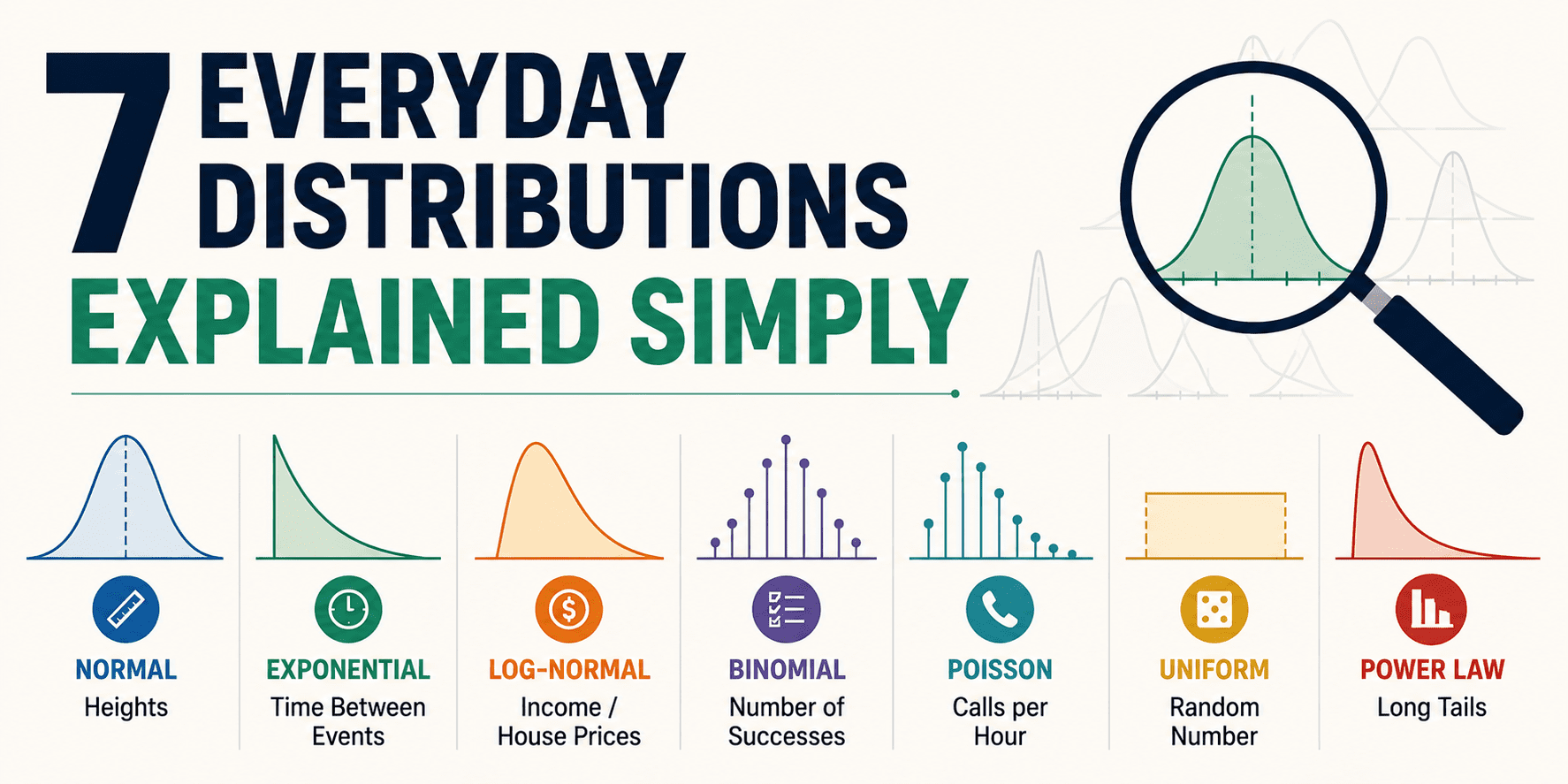
Among the discussions are familiar examples for each distribution that illustrate how each one works in practical situations: normal for heights, binomial for yes/no outcomes, Poisson for rare events over time, exponential for waiting times, lognormal for income and project durations, and power law for social media followers and city size distributions. The article concludes by asserting that these insights will sharpen your ability to identify patterns in data, thereby transforming statistical reasoning into a tool akin to pattern recognition.
Key Points:
- Understanding Data Patterns: Knowing the types of statistical distributions helps in effectively interpreting everyday data patterns.
- Distribution Types: The article covers seven key distributions: normal, uniform, binomial, Poisson, exponential, lognormal, and power law.
- Real-World Examples: Each distribution is explained with practical examples such as heights for normal, yes/no outcomes for binomial, and rare events for Poisson.
- Insightful Interpretation: Recognizing these distributions aids in understanding what’s normal, random, and unusual in data.
- Practical Use: Familiarity with distributions makes statistical reasoning more intuitive and applies to everyday observations.