Could AI Finally Make Flying Out Of Detroit Metro Less Frustrating?
Could AI Finally Make Flying Out Of Detroit Metro Less Frustrating?
Publish Date: 2026-06-25 10:54:00
Source Domain: mitechnews.com
Using an unordered list, summarize the following article with between 4 and 8 key points.
DETROIT — Imagine you’re flying from Detroit to Seattle for an important business meeting.
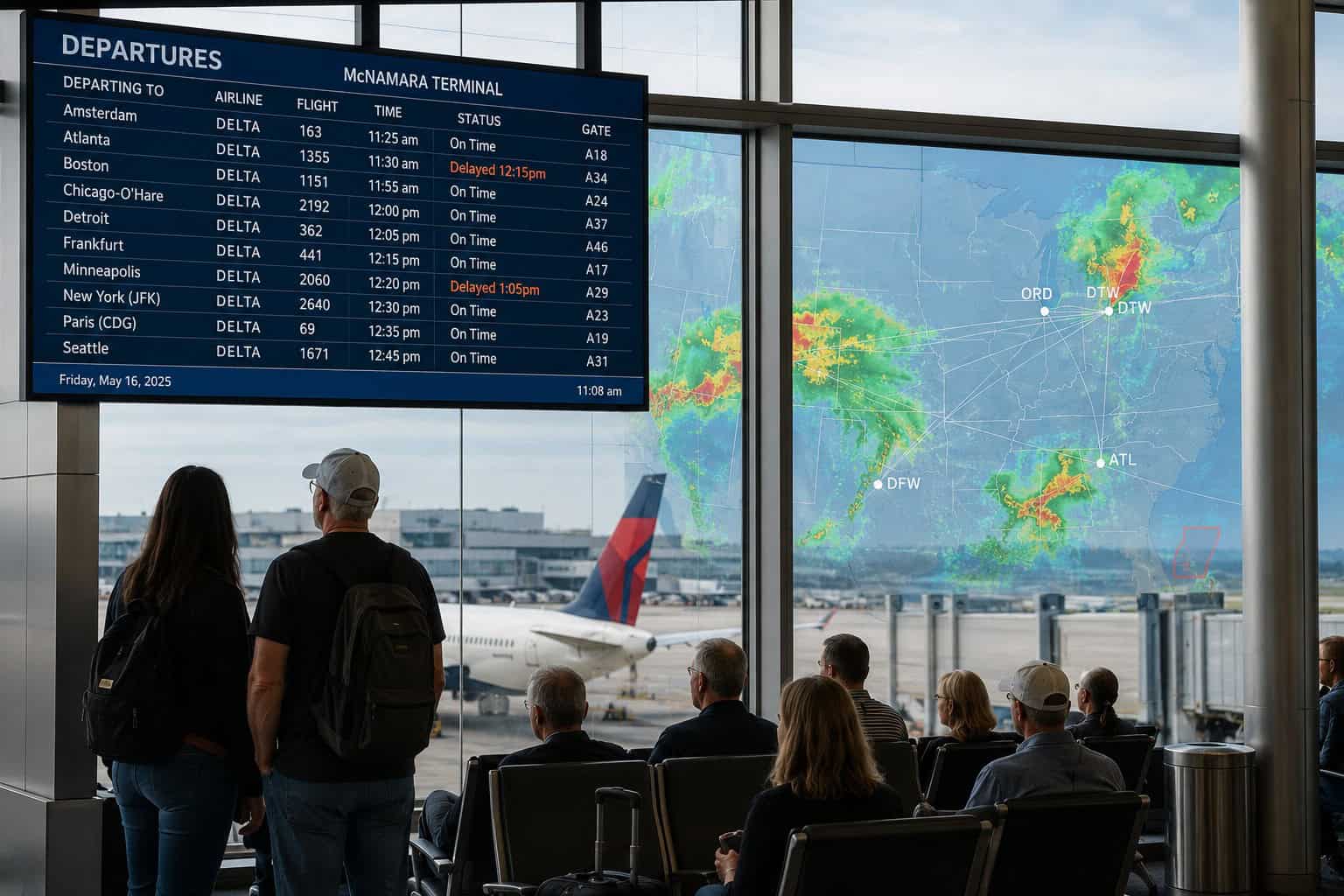
The skies over Southeast Michigan are clear and your aircraft is sitting at the gate ready to board. Then your phone buzzes.
“Flight delayed 47 minutes.”
The problem isn’t Detroit.
Hours earlier, thunderstorms rolled through Atlanta, delaying the aircraft scheduled to fly to Detroit before continuing on to Seattle. By the time that jet arrives at Detroit Metropolitan Airport, it’s already behind schedule. Your flight leaves late. Passengers miss connections. Later that same aircraft may continue to another city, spreading delays across the country like falling dominoes.
Now imagine that same storm—but this time, artificial intelligence predicts the disruption before the first aircraft even leaves Atlanta. Airlines adjust schedules, controllers reroute traffic, and what could have become dozens of delayed flights never materializes.
That’s the future the Federal Aviation Administration hopes to build.
The FAA recently awarded an $875 million, 12-year contract to Air Space Intelligence to deploy an artificial intelligence-powered traffic management system called Strategic Management of Airspace, Routes and Trajectories (SMART). Instead of reacting after delays spread throughout the country, SMART analyzes weather forecasts, airline schedules, airport capacity and airspace congestion before aircraft leave the gate. The goal is to identify bottlenecks early enough for controllers and airlines to prevent delays from cascading through the National Airspace System.
For the more than 30 million passengers who travel through Detroit Metro each year, the payoff could eventually be fewer weather-related delays, more reliable connections and a smoother travel experience.
According to University of Michigan aerospace engineering professor Max Z. Li, that’s exactly where artificial intelligence can make the biggest difference.
“I would say it does represent a major step forward because traditionally we haven’t seen the integration and safe adoption of these more AI-driven tools,” Li told MITechNews.
Detroit Metro By The Numbers
More than 30 million passengers annually
More than 800 flights every day
Service across North America, Europe and Asia
About 80 percent of flights operate on time, among the best-performing large airports in the United States
Yet roughly one out of every five flights is delayed by at least 15 minutes
Why Your Flight Can Be Delayed Even When Detroit Has Blue Skies
Many travelers assume flight delays begin where they’re flying from.
Often, they start hundreds—or even thousands—of miles away.
Think of America’s aviation system as a giant supply chain. Instead of moving automobiles or computer chips, it’s moving airplanes.
A jet delayed by thunderstorms leaving Atlanta may be scheduled to fly its next leg from Detroit to Seattle. Another aircraft delayed in Chicago may later operate a flight from Detroit to New York. International arrivals from Europe or the Middle East can also affect aircraft scheduled to depart Detroit later in the day.
Researchers call this delay propagation—the ripple effect that spreads delays throughout the aviation network.
Li says artificial intelligence is particularly well suited to solving that problem.
“If you have a good weather forecast and you have a good way of integrating the weather forecast with the flight schedules, then yes, you are able to do pretty good delay propagation modeling,” he said.
Unlike traditional software that largely reacts after delays occur, AI continuously analyzes enormous amounts of operational data and forecasts where congestion is likely to develop before it becomes a problem.
Today’s system reacts to delays. Tomorrow’s system predicts them.
How AI Could Prevent Your Flight Delay
Rather than waiting until delays spread across the country, the FAA hopes SMART will predict problems before they happen.
Step 1: AI analyzes developing weather systems across the country.
Step 2: It compares those forecasts with airline schedules, airport capacity and available airspace.
Step 3: It predicts which flights and aircraft are likely to be delayed—and how those delays will ripple through the national aviation network.
Step 4: Controllers and airline operations centers receive recommendations that allow them to reroute aircraft or adjust schedules before congestion builds.
Step 5: Travelers benefit from fewer delays, fewer missed connections and a more predictable travel experience.
AI Will Help Controllers—Not Replace Them
Whenever artificial intelligence enters the workplace, one question almost always follows:
Will it replace people?
Li says that’s not what will happen in aviation.
“Humans will need to stay in the loop whenever there is a safety-critical juncture,” he said. “You want people focused on the critical junctures. You don’t necessarily want them stressed out and overburdened with things that could be more easily automated.”
Instead, AI is designed to reduce routine workload while allowing controllers to focus on decisions that directly affect safety.
His comments come as the FAA faces one of its biggest staffing challenges in decades. The agency plans to hire 2,200 new air traffic controllers this year, followed by thousands more over the next two years to replace retiring controllers and meet growing demand.
Rather than eliminating jobs, Li believes modern AI tools could actually make the profession more attractive to younger workers.
“I think the investment the FAA and Department of Transportation are making is really augmenting and helping these air traffic controllers and not replacing them,” he said.
He believes modernizing air traffic control with advanced decision-support technology could encourage more young people to pursue aviation careers while helping experienced controllers manage an increasingly complex airspace.
A New Era For Air Travel
Artificial intelligence won’t eliminate thunderstorms.
It won’t stop snowstorms, hurricanes or mechanical problems.
But it may allow airlines and the FAA to manage those disruptions far more intelligently than they do today.
Li believes AI’s greatest value won’t be replacing pilots or controllers. Instead, it will help thousands of aviation professionals—from controllers and airline dispatchers to airport operations managers—make better decisions before delays spread throughout the system.
“In the best-case scenario, AI truly is a decision-support tool that augments the capabilities of all of these groups,” Li said. “Hopefully the traveling public will see a smoother experience, fewer delays and more options.”
The next time you’re sitting at the gate at Detroit Metro and your flight leaves on time despite storms hundreds of miles away, artificial intelligence may have quietly solved a problem you never knew existed.