Accurate surgery time prediction (ASTP) strategy based on artificial intelligence techniques
Accurate surgery time prediction (ASTP) strategy based on artificial intelligence techniques
https://www.nature.com/articles/s41598-026-55198-1
Publish Date: 2026-06-12 12:51:00
Source Domain: www.nature.com
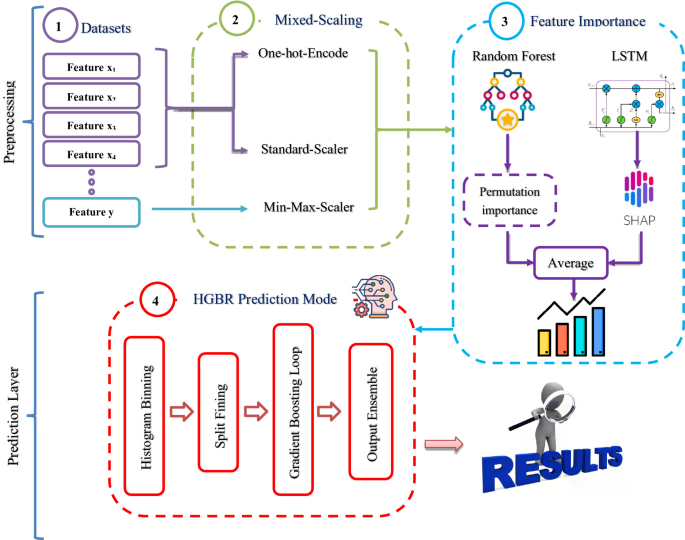
- The proposed Accurate Surgery Time Prediction (ASTP) framework consists of two layers: a preprocessing layer and a prediction layer.
- The preprocessing layer uses techniques such as one-hot encoding, Mixed-Scaling, and methods to determine feature importance using LSTM and Random Forest, followed by feature ranking.
- The prediction layer utilizes Histogram Gradient Boosting Regression (HGBR) to predict surgery duration based on the ranked features.
- The LSTM model applies SHAP to quantify the importance of features, while Random Forest uses permutation importance for feature ranking to ensure robustness.
- The HGBR model quantizes continuous features into bins, evaluates splits at bin boundaries, conducts gradient boosting, and averages predictions in log space for stable outputs.
- The ASTP framework was evaluated on two datasets: the Nile Hospital dataset and the MOVER dataset, using metrics like mean absolute error (MAE), root mean square error (RMSE), and the coefficient of determination (R²).
- HGBR achieved the best performance on both datasets, demonstrating lower mean absolute error and higher R² compared to other models like ANN, LSTM, GRU, and LSTM + GRU hybrids.
- Statistical analysis confirmed that the HGBR-based ASTP model significantly outperformed other comparative models.