Bridging the interpretability gap for medical artificial intelligence models using class-association manifold learning
https://www.nature.com/articles/s41551-026-01676-w
Publish Date: 2026-05-18 09:11:00
Source Domain: www.nature.com
-
AI’s Role in Global Health: The article explores the potential of artificial intelligence (AI) and machine learning (ML) in advancing global health, emphasizing its ability to improve diagnostics and treatment strategies, but also discusses associated ethical concerns and challenges.
-
Ethical and Bias Concerns: There is an ongoing debate on the ethical implications of AI in healthcare, focusing on bias in medical imaging, racial misdiagnosis, and general fairness issues which undermine trust in AI systems.
-
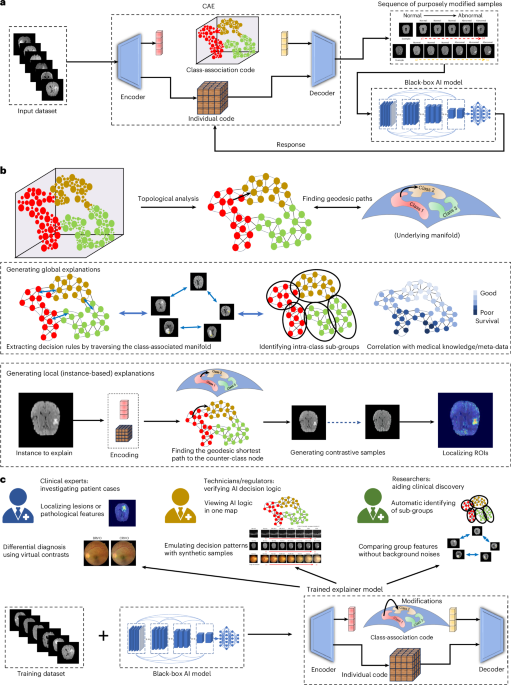
Interpretability and Transparency: The necessity for transparency and interpretability in AI models, particularly in medical applications, is highlighted. Several techniques and frameworks aimed at making AI models understandable to users are discussed.
-
Healthcare Datasets and Benchmarks: The use of large datasets and benchmarks for training and evaluating AI models in healthcare contexts is underscored, showing some examples like radiomics, pathology, and ophthalmic imaging datasets.
-
Advancements in Explainable AI: Recent advancements in explainable AI methods to help elucidate AI decision-making processes are noted, including various feature attribution techniques and visualization methods to provide insights into model behavior.
-
Regulatory Oversight: The regulatory landscape for AI in healthcare is outlined, with discussions on FDA guidelines and the importance of adhering to regulatory standards for AI medical devices.
-
Future Directions: The article concludes by pointing out future directions for research in AI for health, including the integration of AI with clinical workflows, further efforts in model transparency, and the development of robust, reliable AI systems.