Economic evaluation of artificial intelligence for cancer detection in the UK breast screening programme
https://www.nature.com/articles/s41416-026-03465-3
Publish Date: 2026-05-02 16:51:00
Source Domain: www.nature.com
- A de novo discrete-event simulation (DES) model was constructed to assess the cost-effectiveness of integrating AI for cancer detection in the NHS Breast Screening Programme, following NICE and CHEERS-AI guidelines.
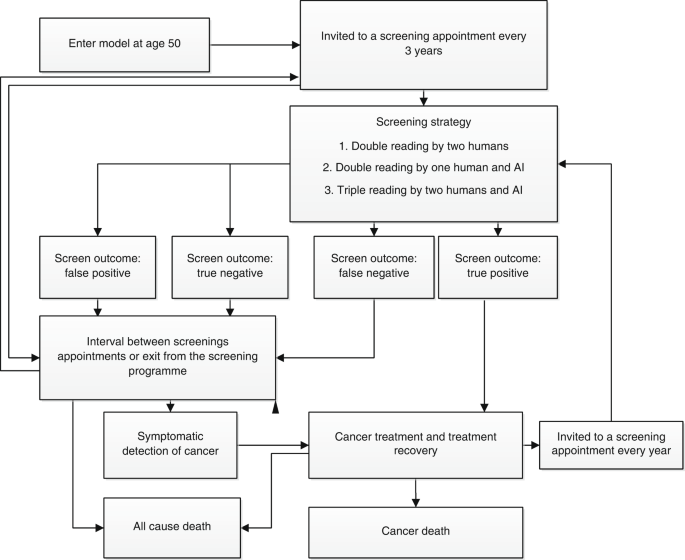
- The DES model replicates the UK breast screening pathway, capturing individual screening and treatment trajectories, capturing long-term benefits like earlier detection, improved survival, reduced recurrence, and lower treatment costs.
- Four screening strategies were evaluated: standard double reading by two radiologists, double reading by one radiologist plus AI, single reading by AI alone, and triple reading (two radiologists plus AI).
- AI system Insight MMG version 1.1.6 (Lunit) was used, incorporating its technical details and accuracy derived from the Swedish ScreenTrustCAD trial.
- The simulation includes a natural history sub-model to determine the underlying tumor onset age and symptomatic cancer detection time.
- Screening attendance, disease stage, survival, and recurrence were modeled probabilistically based on age, breast density, and historical NHS data.
- Costs from a UK payer perspective included screening, follow-up diagnostics, treatment, staffing, AI licensing fees, and end-of-life care, all discounted at 3.5%.
- Health outcomes were calculated using the QALY approach, and a cost-utility analysis was conducted to determine which strategy was most cost-effective at £20,000 per QALY.
- External validation and sensitivity analyses were carried out, assessing the robustness of the model through probabilistic and deterministic approaches.