Context Engineering Explained in 3 Levels of Difficulty
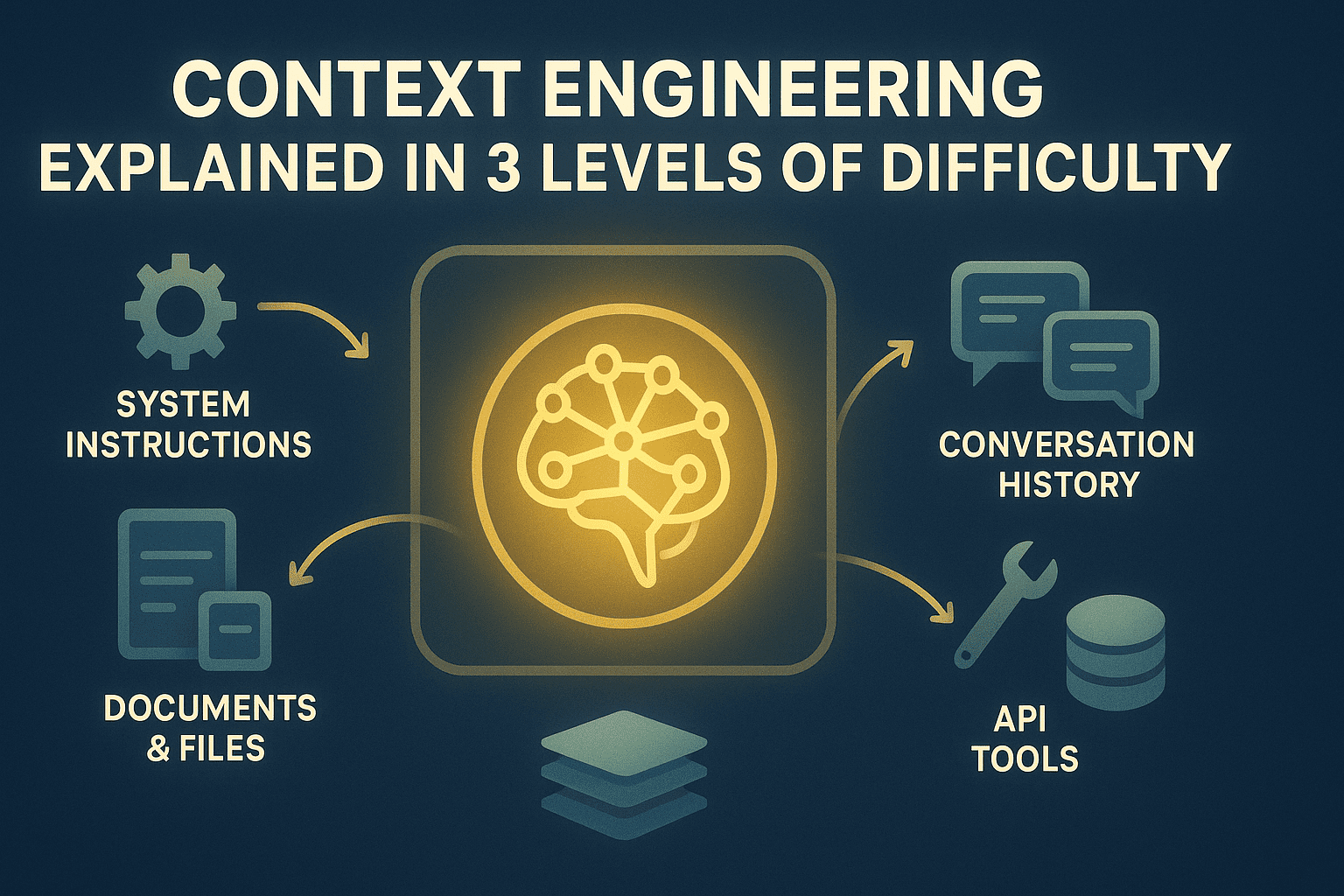
Context Engineering Explained in 3 Levels of Difficulty
https://www.kdnuggets.com/context-engineering-explained-in-3-levels-of-difficulty
Publish Date: 2026-01-06 20:13:21
Source Domain: www.kdnuggets.com
Summary
This article breaks down “context engineering,” a critical practice for managing large language model applications that run into context window limits. Without this practice, LLM applications lose track of instructions, degrade in performance, or even hallucinate by generating incomplete or false information. Context engineering is divided into three levels: understanding the inherent bottleneck of fixed context windows, implementing practical optimization strategies in daily operations, and exploring advanced memory architectures, retrieval systems, and optimization techniques for scaling implementations. At its simplest, context engineering revolves around the continuous curation of information to ensure the LLM has access to all necessary information it needs to perform effectively. Practical optimizations include consciously budgeting tokens, strategically truncating conversations, and leveraging model protocols to fetch data on-demand. Advanced strategies talk about sophisticated memory tiers, compression techniques, and the design of retrieval systems. Overall, effective context engineering ensures that LLM applications can maintain coherence, reliability, and efficiency, even as interactions become more extended and complex.
Key Points:
-
Context Window Bottlenecks: Large language models face inherent limits in their context windows, leading to memory loss or performance degradation during extended interactions.
-
Practical Optimizations: Strategies such as careful token budgeting, conversation truncation, and managing tool outputs through metadata requests help optimize context usage within practical constraints.
-
Advanced Strategies: Include sophisticated memory architectures like working, episodic, semantic, and procedural memory; advanced compression techniques; hybrid search methods for retrieval; and continuous token profiling to reduce waste.
-
Information Architecture: Context engineering is ultimately about crafting an information environment that enables LLMs to remain effective and coherent, making informed decisions about what to compress, retrieve, cache, and discard.
-
Evaluation and Scaling: Tracking key performance metrics, memory retrieval triggers, and multi-document synthesis are essential for scaling context engineering practices and ensuring consistent application performance.