Artificial intelligence for breast cancer management
Artificial intelligence for breast cancer management
https://www.nature.com/articles/s43856-025-01342-3
Publish Date: 2026-01-03 01:33:00
Source Domain: www.nature.com
-
Breast Cancer Stem Cell Antigens for Immunotherapy: The article discusses targeting breast cancer stem cell antigens to develop immunotherapies.
-
Global Cancer Statistics and Trends: Recent data reveals the global incidence and mortality rates of cancer, including breast cancer, highlighting its prevalence across different regions.
-
AI in Cancer Diagnosis and Treatment: AI is increasingly used in assisting cancer diagnosis and treatment planning, especially in breast cancer, leveraging advanced imaging techniques and data analysis.
-
Computer-Aided Detection Systems: AI-driven computer-aided detection (CAD) systems are significantly improving the accuracy and efficiency of breast cancer screening through mammography and other imaging modalities.
-
Artificial Intelligence Adoption in Screening Programs: Studies show that AI-integrated pathways in mammography screening can reduce radiologist workload while maintaining or enhancing cancer detection performance.
-
Precision Medicine and Imaging Techniques: AI’s role in precision medicine, including predicting treatment outcomes and classifying breast cancer subtypes, is growing, often integrating with advanced imaging like MRI and ultrasound.
-
Clinical Trials and AI Applications: Numerous clinical trials are exploring AI’s potential in predicting treatment responses, detecting tumors, and personalizing therapy for breast cancer patients.
-
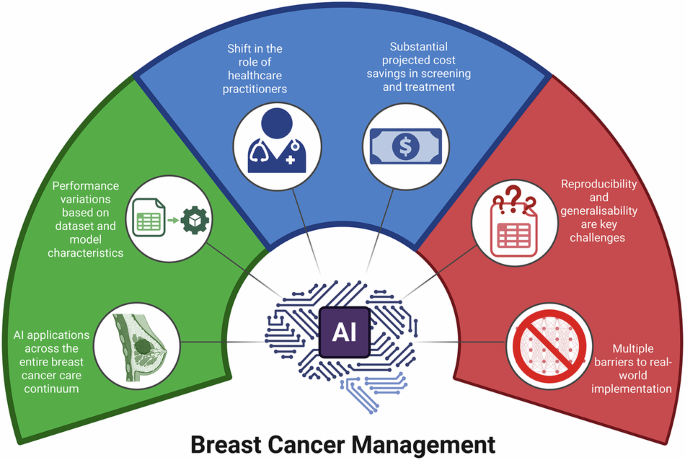
Cost-Effectiveness and Implementation Challenges: While AI shows promise in enhancing breast cancer detection and treatment, cost-effectiveness and integration challenges need addressing for its widespread adoption. Ethical considerations and the role of AI in complementing—not replacing—medical professionals are also critical.
-
Global Accessibility and Equitable Implementation: The potential of AI to transform healthcare—especially in low-resource settings—is highlighted, along with considerations around equitable access and implementation strategies.
-
Ethics and Future Perspectives: The evolution of AI in breast cancer care involves profound ethical considerations surrounding bias, transparency, and the future role of AI in clinical decision-making.