Artificial intelligence-driven approaches for materials design and discovery
Artificial intelligence-driven approaches for materials design and discovery
https://www.nature.com/articles/s41563-025-02403-7
Publish Date: 2026-01-02 05:25:00
Source Domain: www.nature.com
- The article discusses the advanced computational methods used in the design of hierarchically structured materials, emphasizing the role of both traditional theoretical approaches and modern machine learning techniques.
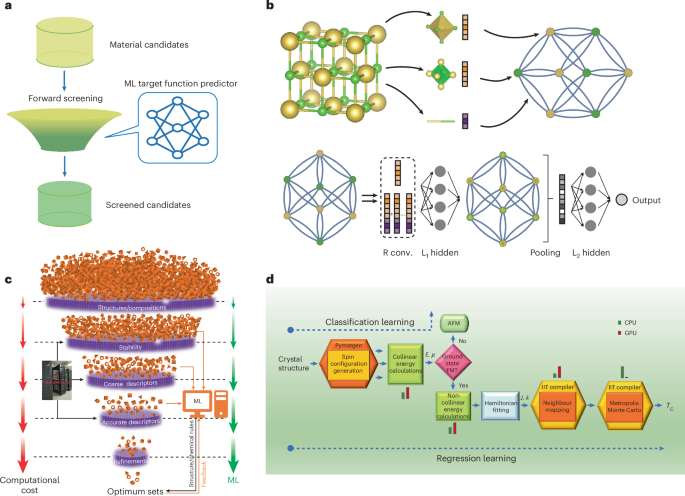
- Notable techniques highlighted include the use of generative models, reinforcement learning, Bayesian and other optimization algorithms, and graph neural networks for understanding and designing materials with targeted properties.
- Papers review progress in specific applications, including discovery of superconductors, thermoelectric materials, and new metal-organic frameworks, showcasing the integration of theoretical models and practical applications.
- The importance of using high-throughput computation and automation in laboratory settings, often driven by large language models and AI agents, is prevalent throughout the discussions.
- The role of data-driven approaches in bridging the gap between theoretical predictions and experimental validation, enhancing efficiency in materials discovery and design, is a recurrent theme.
- The potential of machine learning, especially in conjunction with symmetry and physical constraints, is emphasized as a critical tool in generating new materials with desired properties without exhaustive experimentation.