Self-Hosted LLMs in the Real World: Limits, Workarounds, and Hard Lessons
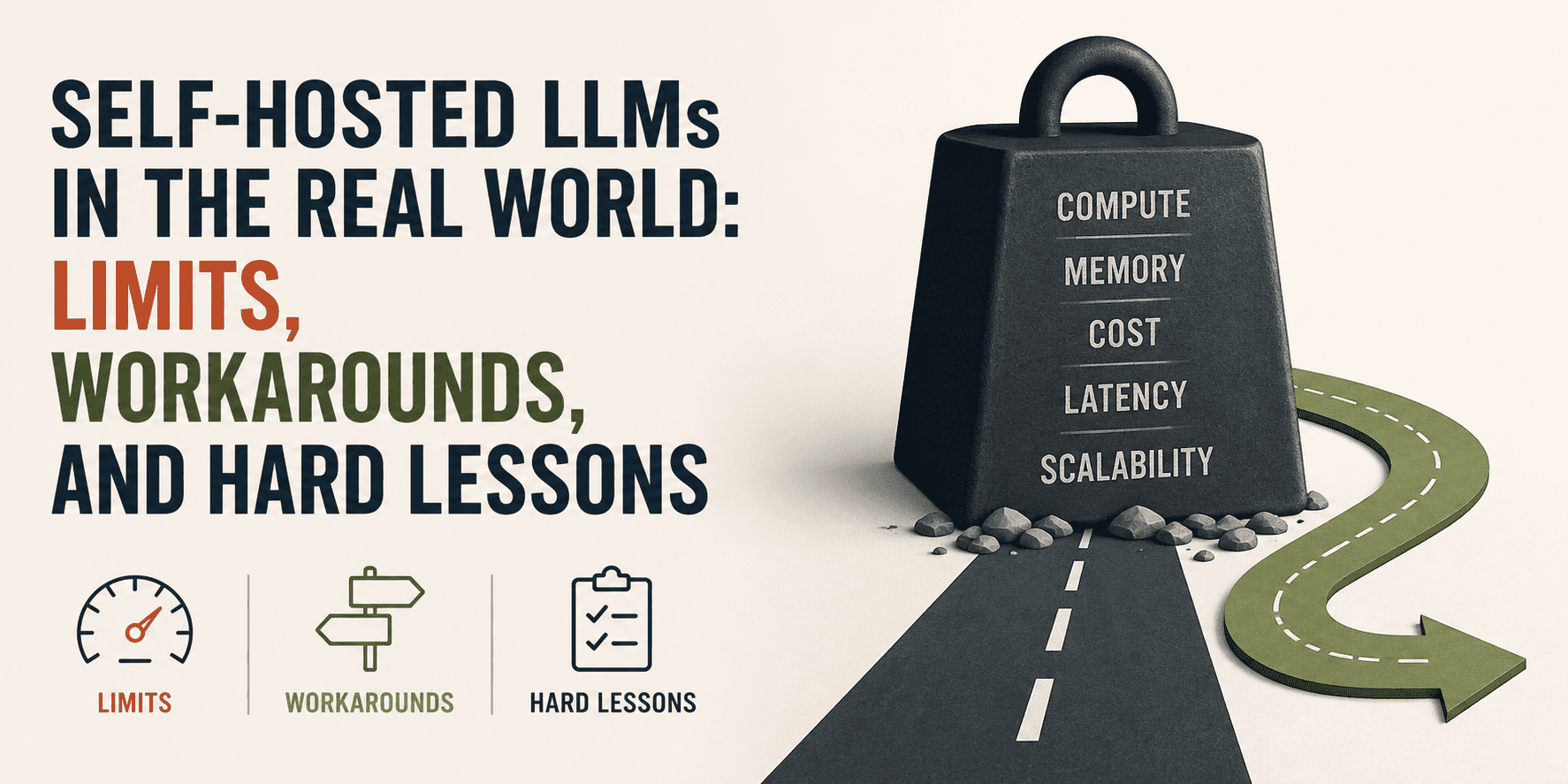
Self-Hosted LLMs in the Real World: Limits, Workarounds, and Hard Lessons
https://www.kdnuggets.com/self-hosted-llms-in-the-real-world-limits-workarounds-and-hard-lessons
Publish Date: 2026-07-11 02:50:03
Source Domain: www.kdnuggets.com
Summary of Article
Running your own large language model (LLM) promises the allure of control, cost savings, and no data leaving your servers. However, as the article discusses, the operational hurdles that arise often dwarf initial expectations. The author explores various challenges, beginning with the assumption that anyone can easily access the hardware necessary to run an LLM without running into severe resource limitations. This includes dealing with GPU memory, which requires a significant investment in high-end graphics cards running multiple GPUs for models that exceed 7 billion parameters. Quantization of models to overcome these limitations results in compromises on precision, especially for complex tasks. Another significant challenge comes from managing context windows and memory. The practical implication is that larger context windows not only consume massive memory but also slow down processes dramatically. High latency in responses further exacerbates the usability problem and slows the development cycle. Adapting and switching prompt templates between hosted and self-hosted models is non-trivial and can cause inconsistent results. Even the process of fine-tuning, which seems logical for domain-specific improvements, turns out to be a complex task that requires well-prepared, high-quality data and considerable effort. The final takeaway is that while tools like Ollama and vLLM have made self-hosting more accessible, the process still demands significant patience, technical acumen, and investment. Expecting an easy transition is misleading; it requires embracing the challenges as an inherent part of the experience.
Key Points:
-
Hardware Challenges:
- Self-hosting LLMs necessitates powerful hardware, with specific requirements depending on model size.
- Quantization, though necessary for managing hardware limitations, reduces model precision.
-
Context Windows and Memory Management:
- Practical context window sizes are larger than expected and management is complex due to quadratic memory scaling.
-
Latency Issues:
- Self-hosted models often have noticeable latency that slows down development cycles and usability.
-
Prompt Template Adaptation:
- Switching from hosted to self-hosted LLMs often requires re-adaptation of prompt templates to align with the model’s structure.
-
Fine-Tuning Obstacles:
- Fine-tuning models for specific tasks is a demanding process that relies on high-quality data and significant computational effort.