Artificial intelligence could reshape research and care in disorders of consciousness
Artificial intelligence could reshape research and care in disorders of consciousness
https://www.nature.com/articles/s41582-026-01229-4
Publish Date: 2026-06-27 05:02:00
Source Domain: www.nature.com
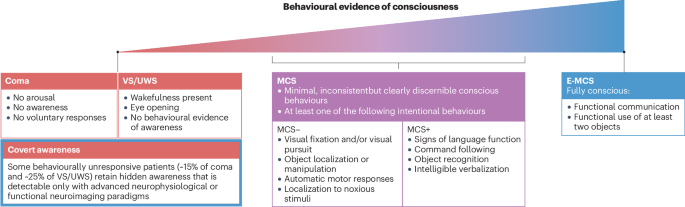
- The article and related citations provide an overview of recent advancements in the diagnosis and understanding of coma and disorders of consciousness.
- Kondziella et al. (2020) present a European Academy of Neurology guideline for diagnosing coma and disorders of consciousness, highlighting key clinical criteria.
- Claassen et al. (2019) demonstrate the use of advanced neuroimaging to detect brain activation in patients who appear unresponsive, offering potential for improved diagnosis.
- Magliacano et al. (2022) validate a machine learning-based prognostic index which uses Coma Recovery Scale-Revised subscores for predicting recovery in prolonged disorders of consciousness.
- Olchanyi et al. (2025) utilize automated MRI segmentation to identify brainstem nuclei that are critical to consciousness, further refining the understanding of brain function in altered states of consciousness.
- Amiri et al. (2023) conduct the CONNECT-ME study, focusing on multimodal prediction of residual consciousness in the intensive care unit, integrating various diagnostic tools.
- Manasova et al. (2026) present a comprehensive multimodal multicenter investigation aiming to validate diagnostic and prognostic markers for disorders of consciousness.
- Toker et al. (2026) explore artificial intelligence to reveal mechanisms and potential treatments for disorders of consciousness, leveraging computational models to understand and address these conditions.
- Salles and Farisco (2024) propose a collaboration between neuroethics and AI ethics to better address ethical issues arising from advanced neurotechnological research and applications.