Adrian Bertagnoli on Heterogeneous Intelligence
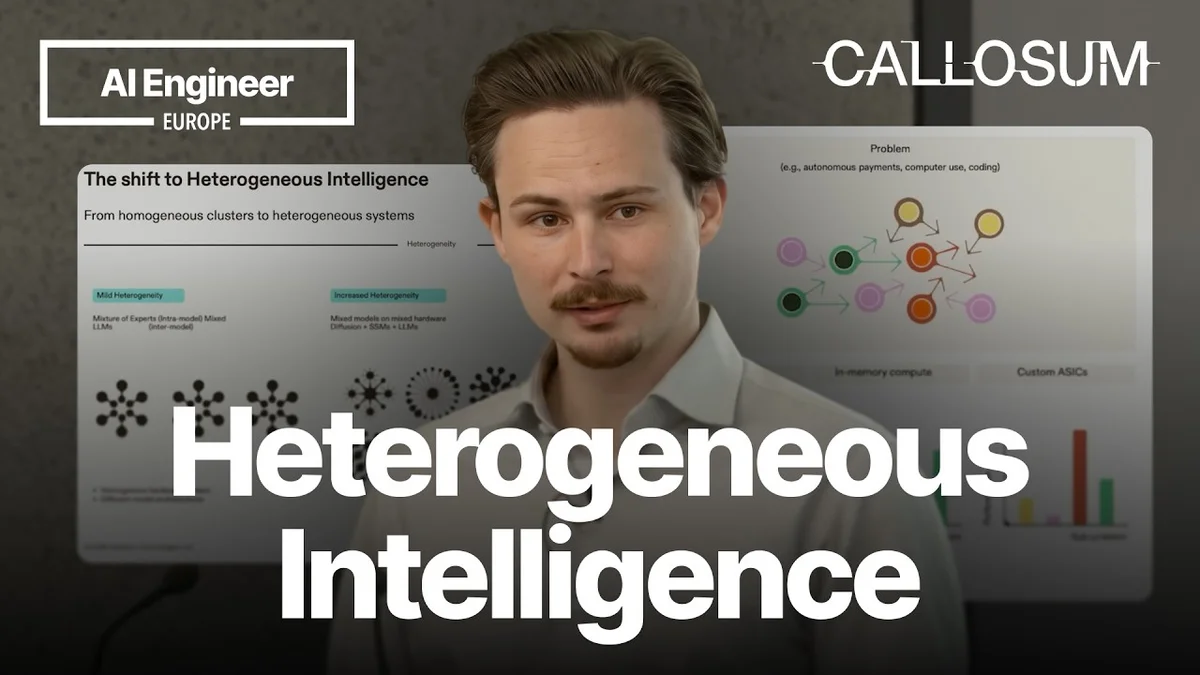
Adrian Bertagnoli on Heterogeneous Intelligence
Publish Date: 2026-05-27 22:02:00
Source Domain: www.startuphub.ai
-
Current Paradigm Limitation: The current paradigm, known as homogeneous AI dominance, is dominated by scaling single models on identical hardware. However, this approach faces limitations when tackling real-world complexities that are inherently multi-step and open-ended.
-
Shift to Heterogeneous AI: There is a significant shift towards heterogeneous intelligence, which involves utilizing diverse, specialized AI components and adapting to varied and complex problems.
-
Nuanced Approach for Complex Problem Solving: The move to heterogeneous AI allows AI systems to efficiently tackle multi-step, open-ended challenges by leveraging the right tools (models and hardware) for specific tasks.
-
Future Compute Readiness: This new paradigm of heterogeneous AI not only advances current capabilities but also prepares the technology to meet future, diverse computational demands efficiently.
-
Theoretical Foundation by Callosum: Adrian Bertagnoli’s company, Callosum, has articulated the theoretical foundations of this paradigm, termed “Maximum Heterogeneity,” which emphasizes optimal performance through diversity in computational workloads across different models and hardware.
-
Benchmark Results: Callosum’s implementation of heterogeneous AI showed substantial improvements in efficiency, with benchmarks indicating up to 12 times cheaper and 5 times faster inference compared to existing models like GPT-5.2.
-
Active Perception and Optimization: The system utilizes active perception to dynamically match sub-tasks to the most suitable models and hardware, significantly enhancing efficiency and performance.
-
New Paradigm of Compute: The future of computational AI will shift toward making compute more heterogeneous, moving beyond simply enhancing speed and parallel processing to combining specialized tools uniquely suited to different tasks.