Table tennis robot defeats some of world’s best players – why this has major implications for robotics
Publish Date: 2026-04-28 07:45:00
Source Domain: theconversation.com
-
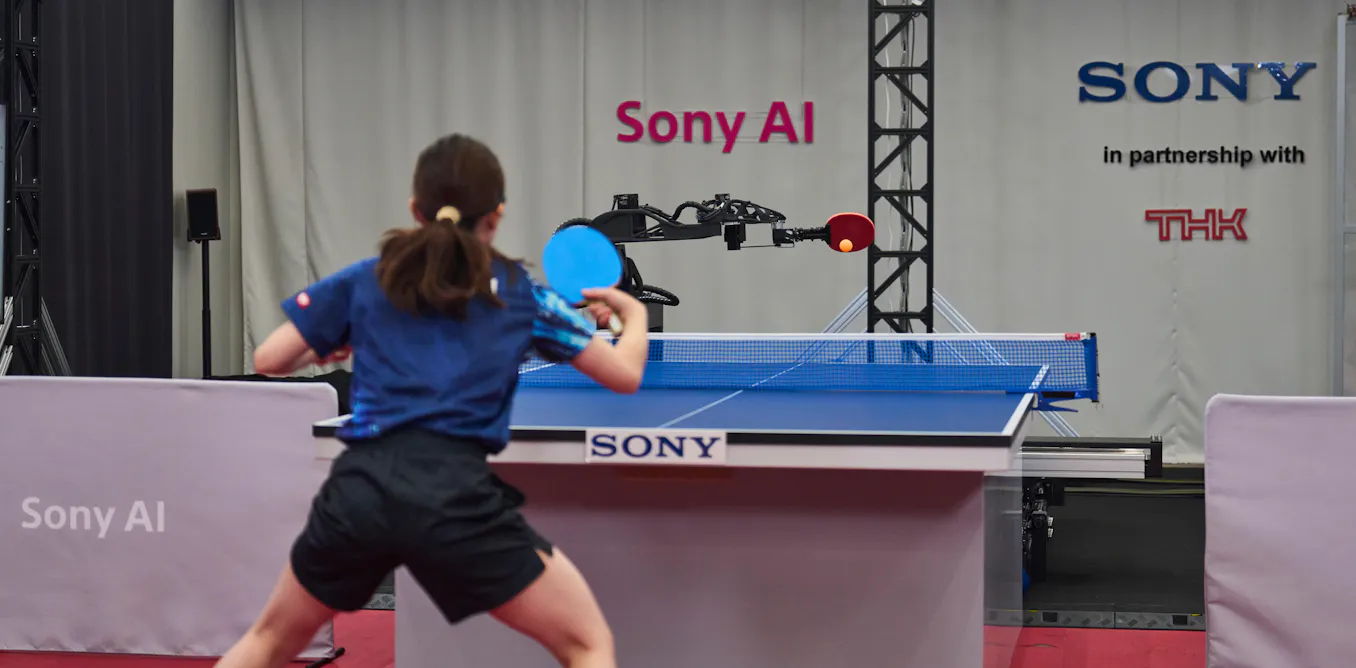
Table Tennis Robot Ace Overperforms against Elite Players: The Sony AI-developed robot named Ace successfully won against elite players in a series of matches, demonstrating significant advances in AI technology.
-
Real-World Adaptability: Ace showcases AI that thrives in fast, uncertain, real-world environments, a crucial step in developing systems that function well in diverse conditions.
-
Key Technological Innovations: Ace’s success relies on three major innovations: advanced high-speed vision sensors for real-time precision, deep reinforcement learning for instant response, and a high-performance robotic arm for rapid and precise movement.
-
Reduced Sim-to-Real Gap: Ace successfully transitions from virtual simulation to real-world performance with minimal errors, bridging a significant gap in AI system development.
-
Implications Beyond Table Tennis: Ace’s capabilities suggest potential for adaptable, responsive robot automation in various industries, enabling them to operate in unstructured environments safely and effectively.
-
Enhanced Human-Robot Interaction: Ace’s ability to operate at the edge of human reaction time suggests a future where robots can collaborate safely with humans in shared spaces.
-
Limitations and Future Enhancements: Although Ace performs remarkably, human players still exploit its limitations, indicating room for further advancements in physical embodiment to enhance human potential.
-
Broader AI Horizons: The development of robots like Ace points towards a future where AI extends beyond abstract problem-solving into the physical world, effectively integrating intelligence with real-time physical interactions.